Renault
Floride, Caravelle
1958-1968
Renault entered the growing market for stylish compact sports cars with the Floride, unveiled at the Paris Motor Show in October 1958. Designed by Pietro Frua and based on the Renault Dauphine, it was available as a coupé, cabriolet and convertible with a removable hardtop. In North America and the UK it was marketed from the outset as the Caravelle. Power came from an 845 cc rear-mounted engine producing 37 hp, while a Gordini-tuned version offered 40 hp. The bodies were built by Brissonneau & Lotz, as Renault lacked sufficient production capacity. For the 1960 model year, the Floride received Renault’s new Aérostable suspension, significantly improving ride comfort and handling, helping the model achieve much stronger sales.
1959

Renault Floride
brochure, 14 pages, Dutch
published c1959
Dating
publicity code 45.816
1960

Renault Floride
brochure, 12 pages, Dutch
published c1960
Dating
the car features the new suspension introduced for the 1960 model year

Renault Floride
folder, 12 pages, Dutch
published c1960
Dating
publicity code 45.864
1962

Renault Floride S
brochure, 16 pages, Dutch
published 1962
Dating
the Floride S was introduced in 1962, publicity code 45.947
From 1962 onwards, the Floride was renamed Caravelle in all markets. At the same time it received a new 956 cc engine from the Renault 8, a standard four-speed gearbox, improved suspension and four-wheel disc brakes - the first French mass-produced car to feature them. A more powerful 1,108 cc engine followed in 1964. Despite these upgrades, increasing competition gradually reduced demand, and production came to an end in 1968.
1962

Renault Caravelle, Floride S
folder, 4 pages, Dutch
published c1962
Dating
1962 was a transition year in which both models were offered
1964

Renault Caravelle 1100
sheet, Italian
published c1964
Dating
in 1964 the Caravelle was given a 1,100 cc engine
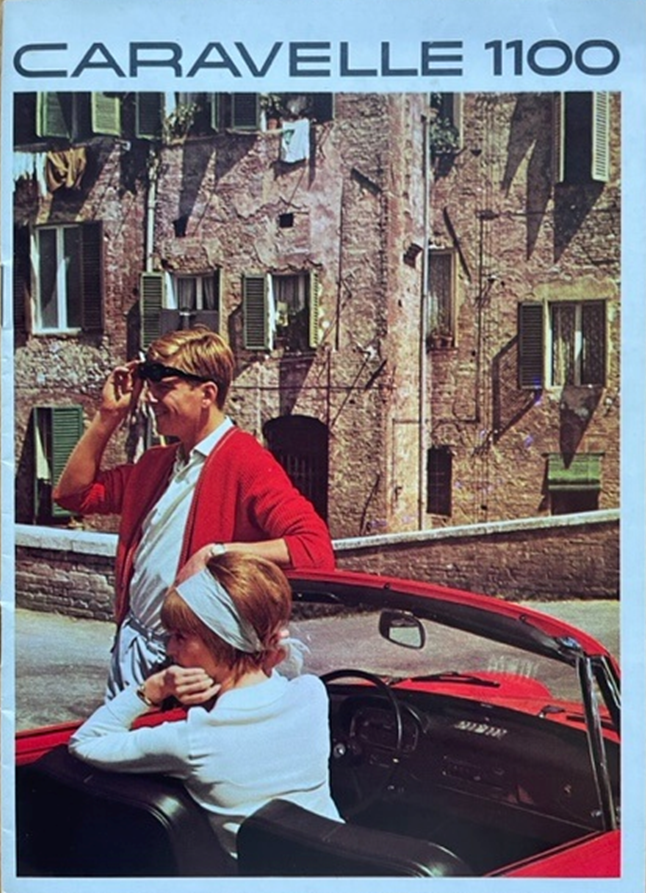
Renault Caravelle 1100
brochure, 16 pagers, Dutch
published c1964
Datering
the French brochure has code 46.001
1966

Renault Caravelle 1100 S
brochure, 16 pages, Dutch (Belgium)
published c1966
Dating
the French brochure has publicity code 46.117
Maak jouw eigen website met JouwWeb