Chevrolet
Corvette
1953-present
Harley Earl, as head of GM's Styling Section, was an avid fan of sports cars. He recognized that GI's returning after serving overseas during World War II, were bringing home MG's, Jaguars and Alfa Romeo's. In 1951, Nash Motors began selling an expensive two-seat sports car, the Nash-Healey, that was made in partnership with the Italian designer Pininfarina and British auto engineer Donald Healey, but there were few moderate-priced models. Earl convinced GM that they needed to build an all-American two-seat sports car and with his Special Projects crew began working on the new car in late 1951. The Corvette prototype was first shown to the public at the January 1953 General Motors Motorama at the Waldorf-Astoria hotel in New York City, series production began six months later. The Corvette would become the most popular American sports car in history, synonymous with freedom and adventure.
1957

Chevrolet Corvette
folder, 6 pages, English (USA)
published 1956
Dating
©1956 is printed on page 2
The 1958 Corvette received body and interior revisions, including a longer front end with quad headlamps, bumper exiting exhaust tips, a revised steering wheel and a dashboard with all gauges mounted directly in front of the driver. The 1959–60 model years had few changes except a decreased amount of body chrome and more powerful engine offerings.
1960

Chevrolet Corvette
folder, 8 pages, English (USA)
published 1959
Dating
©1959 is printed inside
1961

Chevrolet Corvette
folder, 6 pages, English (USA)
published 1960
Dating
©1960 is printed on page 2
The origins of the second generation Corvette – the Sting Ray – go back to the 1957 design study Q-Corvette and the 1959 Sting Ray Racer. GM’s Vice President of styling Bill Mitchell visited the 1957 Salone dell'Automobile di Torino and was inspired by cars on display like the Abarth 750 Streamliner and the Alfa Romeo Disco Volante. By the fall of 1959, elements of the Q-Corvette and the Sting Ray Racer would be incorporated into experimental project XP-720, which was the design program that led directly to the production of the 1963 Corvette Sting Ray.
1965

Chevrolet Corvette Sting Ray
brochure, 16 pages, English (USA)
published 1964
Dating
©1964 is printed on page 2
1966
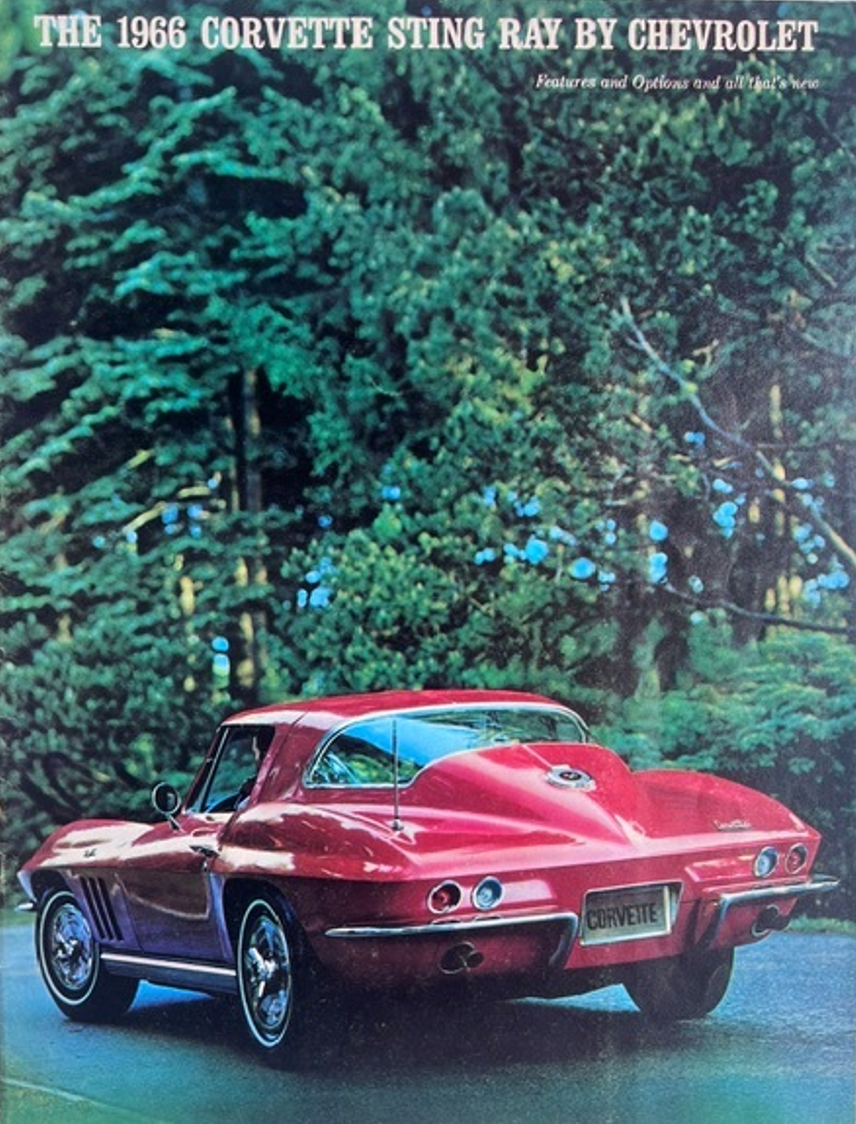
Chevrolet Corvette Sting Ray
brochure, 16 pages, English (USA)
published 1965
Dating
©1965 is printed on page 2
The third generation Corvette was produced from 1967 until 1982. Engines and chassis components were mostly carried over from the previous generation, but the body and interior were new. The design was strongly influenced by the Mako Shark II concept car, especially the pointy shark nose. It featured the first use of T-top removable roof panels. The third generation Corvette was a succesful model with a record 53,807 units produced for the 1979 model year.
1974

Chevrolet Corvette
brochure, 8 pages, English (USA)
published 09-73
Dating
September 1973 is printed on the back
1975

Chevrolet Corvette
brochure, 8 pages, English (USA)
published 09-74
Dating
September 1974 is printed on the back
1976

Chevrolet Corvette
folder, 6 pages, English (USA)
published 09-75
Dating
September 1975 is printed on the back
1978

Chevrolet Corvette
folder, 12 pages, English (USA)
published 07-77
Dating
July 1977 is printed on the back
1979

Chevrolet Corvette
folder, 12 pages, English (USA)
published 07-78
Dating
July 1978 is printed on the back
Maak jouw eigen website met JouwWeb