Lancia
Appia
1953-1963
Introduced at the Turin Motor Show in 1953, the Lancia Appia replaced the pre-war Ardea as the company’s compact saloon. Its elegant styling closely resembled a smaller Aurelia, while underneath it retained several traditional Lancia features, including sliding-pillar front suspension and a narrow-angle 1,089 cc V4 engine producing 38 PS. Drive went to the rear wheels through a four-speed gearbox. The pillarless body featured distinctive rear-hinged back doors, while early examples used aluminium for the doors, rear wings and bumpers to save weight. With its sophisticated engineering and high-quality interior, the Appia was relatively expensive and initially sold below expectations. Nevertheless, 20,025 Series I saloons were produced before Lancia introduced a substantially improved version in 1956.
1954

Lancia Appia
folder, 4 pages, Italian, French, English
published c1954
Dating
this is a first series model (1953-1956)
Introduced at Geneva in 1956, the Series II addressed many shortcomings of the original Appia. The wheelbase and body were lengthened, improving rear accommodation and luggage space, while steel bumpers and rectangular front indicators provided visual differences. The 1,089 cc V4 was extensively revised and now produced 43 PS. Inside, a front bench replaced the separate seats and the instruments were redesigned. The improved Appia proved more convincing, with 22,425 Series II saloons ultimately produced.
1958
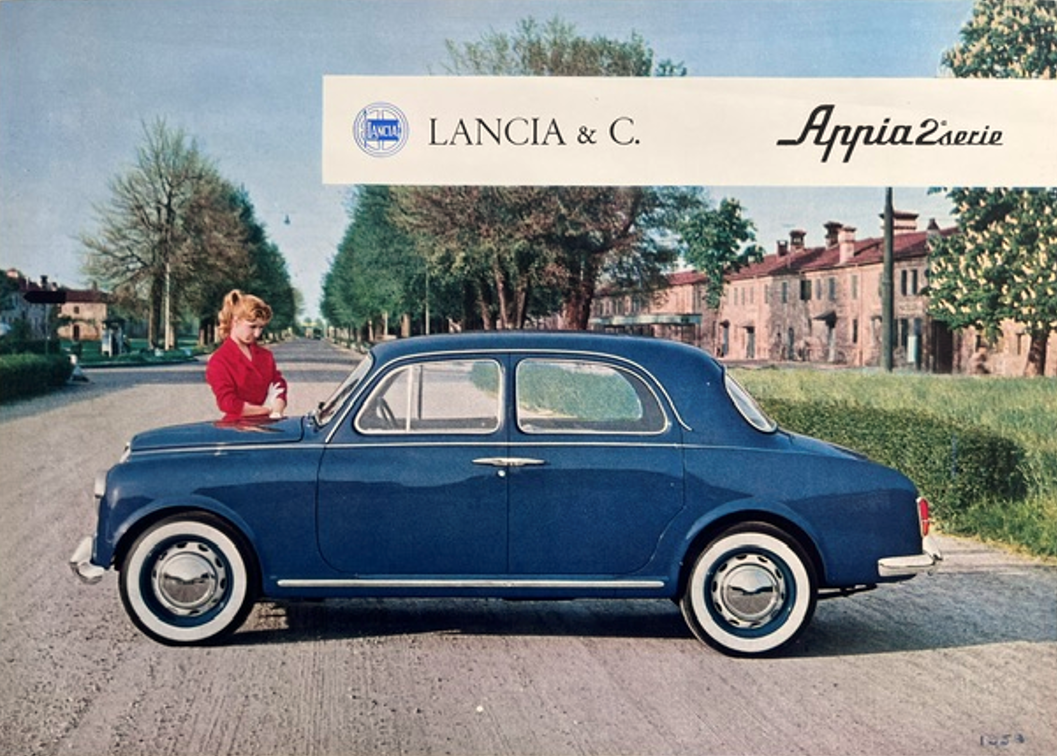
Lancia Appia
sheet, Italian
published c1958
Dating
publicity code 009169
The Series III appeared at Geneva in 1959 and gave the Appia a noticeably more modern appearance. Its traditional shield-shaped Lancia grille disappeared, replaced by a wide horizontal design inspired by the larger Flaminia. Power from the familiar 1,089 cc V4 increased to 48 PS, raising top speed to 132 km/h, while the braking system was improved. This final and most successful Appia was produced until 1963, with 55,577 saloons built before the Fulvia succeeded it.
1961

Lancia Appia
folder, 6 pages, English
published 12-61
Dating
publicity code 8799024 12/61
Maak jouw eigen website met JouwWeb