Citroën
7CV, 11CV, 15CV (Traction Avant)
1934-1957
In April 1934 the Traction Avant was presented at Citroën's huge showroom in Paris. It was the world’s first unibody front-wheel-drive car, consisting of a range of mostly four-door saloons and executive cars, with four or six-cylinder engines. Whilst front-wheel drive and independent suspension had been established in the mass market by Auto Union some years before, the Traction Avant pioneered mass-production of a crash resistant, unitary, monocoque body. Additionally, the car was also an early adopter of rack and pinion steering. Traction Avant, which translates as "front wheel drive," is not the official name. The car was named according to the French fiscal horsepower rating, or CV, used to determine annual car tax levels. The official designations were 7CV, 11CV and 15CV. During the early stages of World War II in June 1940, the factory suffered serious damage caused by a German air attack. Production of the cars was suspended in June 1941 only to restart in 1945. The Traction Avant was discontinued in July 1957, directly after the introduction of the ID.
1954

Citroën 11 berline
folder, 4 pages, Dutch
published c1954
Dating
in 1953 an external boot was fitted, in 1955 the engine power is increased to 60hp, in this folder it is still 56hp
1955
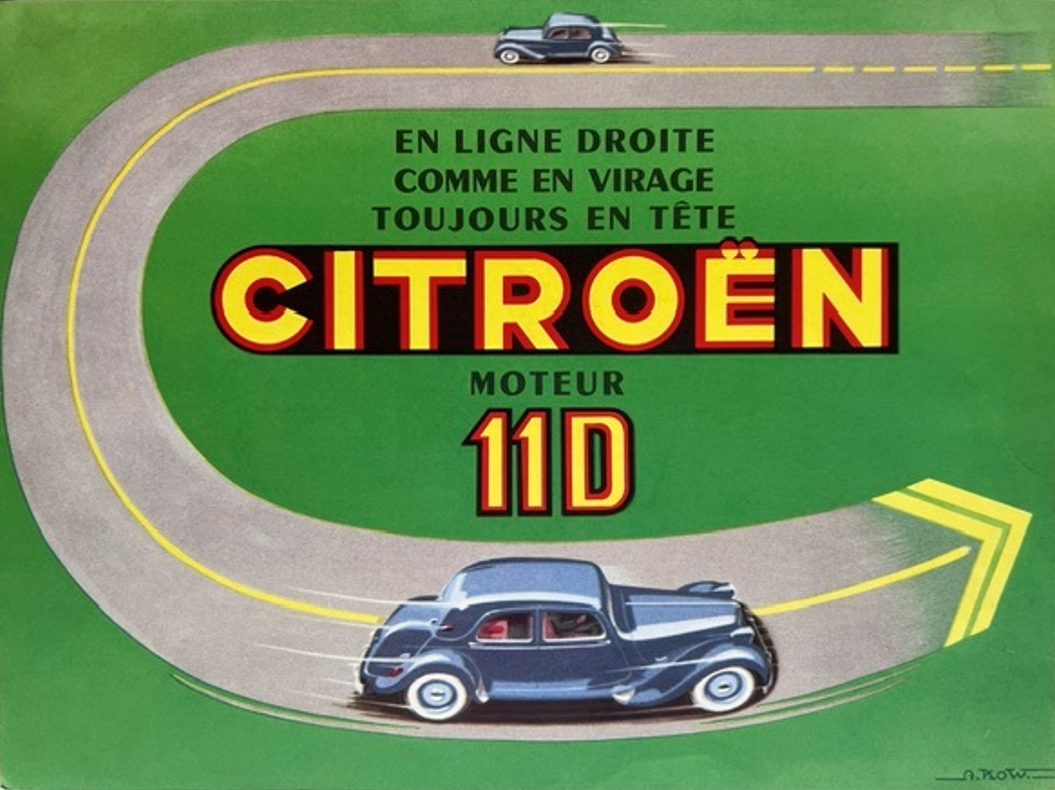
Citroën 11D
folder, 4 pages, French
published c1955
Dating
the 11D was introduced in 1955; in the folder it is presented as new
publicity code A.C. 5.131
Maak jouw eigen website met JouwWeb