Vauxhall
Victor, VX, Ventora
1957-1978
In February 1957 the Vauxhall Victor (F series) was introduced to replace the outgoing Wyvern. The body style was derived directly from the classic 1955 Chevrolet Bel Air, featuring a large glass area with heavily curved windscreen and rear window. A station wagon was launched in 1958 and a series II model with simplified styling was announced a year later.
1957

Vauxhall Victor
brochure, 16 pages, Dutch
published 07-57
Dating
code J 1747 - Fl/N 432007-7-31 VPS
1960
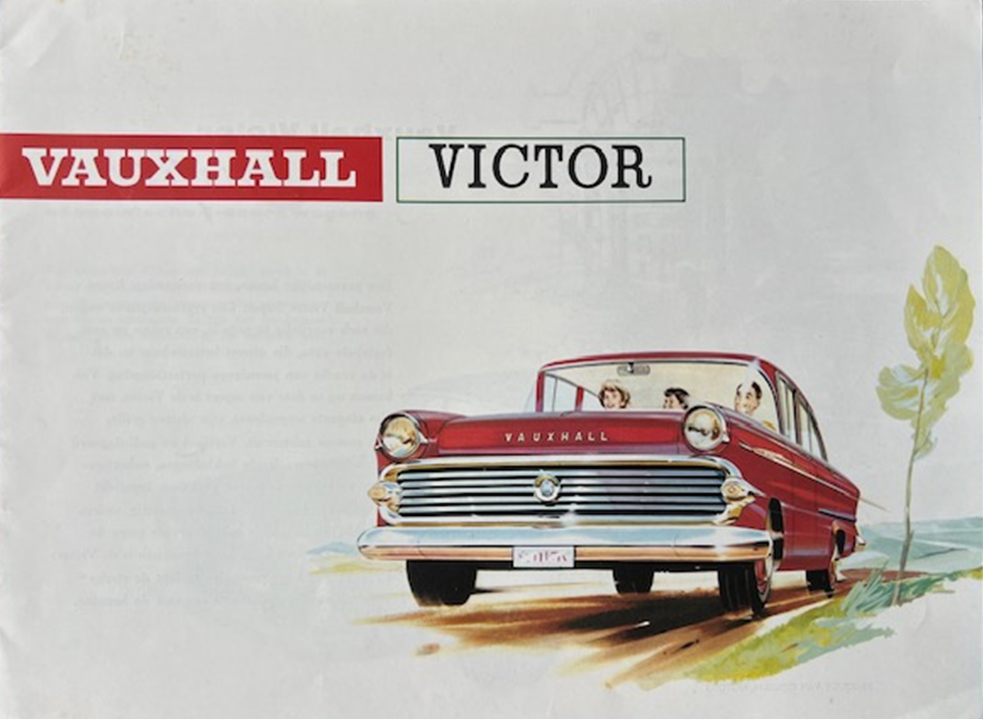
Vauxhall Victor
brochure, 12 pages, Dutch
published 11-60
Dating
code J 2149 - FI/N 273000-11-20 VPS
In September 1960 the more cleanly styled FB series Victor was announced. Mechanically, the main change was the option of a 4-speed all-synchromesh transmission with floor change. A sporty derivative, the VX4/90, was announced in October 1961. It was available in saloon form only and had a larger 1,595 cc engine. It featured front disc brakes, 14 inch wheels and bucket seats in the front. In September 1963 the regular engine was enlarged from 1,508 to 1,594 cc. Models with the larger engine had a revised frontal treatment with a block style grille element and revised parking lights at either lower extreme of the grille.
1961

Vauxhall Victor, VX4/90
brochure, 16 pages, Dutch
published 08-61
Dating
publicity code VX 1315/8/61

Vauxhall Victor
brochure, 16 pages, English
published 09-61
Dating
publicity code V 1314/9/61
1963

Vauxhall Victor, VX 4/90
brochure, 16 pages, Dutch
published 01-63
In 1963 the FC series Victor entered the market. It was the first Vauxhall to use curved side-window glass, allowing greater internal width; the station wagon was noted as being especially spacious for its class. Nevertheless, the public at the time regarded it as a qualitative downgrade after the pleasantly styled, conservative FB. As a countermeasure the FC Victor was marketed as the Victor 101, the name arising from the claim that there were '101 improvements' over the FB. The VX4/90 was, by this time, largely overshadowed by the less expensive Ford Cortina GT, which also had a higher profile in race and rally competitions.
1963

Vauxhall Victor, VX 4/90
folder, 4 pages, Dutch
published c1963
Dating
the text indicates it is a new model
1965

Vauxhall VX4/90
folder, 8 pages, Dutch
published 05-65
Dating
code J 2609 - F/D 95005-5-20 VPS
The fourth generation Victor, the series FD, was released in 1967. It was inspired by the contemporary "coke bottle" styling which had emanated from Detroit, USA. The Victor was available with all-new 1,598 cc and 1,975 cc engines and comfortable contoured bucket seats for the Victor 2000. In February 1968 Vauxhall launched the Ventora, which was in effect a marriage of the Victor FD body with the 3.3-litre six-cylinder engine hitherto offered only in the larger Cresta and Viscount models. From the outside Ventoras can be identified by a different front grille and a black vinyl roof.
1968

Vauxhall Victor
brochure, 12 pages, Dutch
published 04-68
Dating
code J 2805-D-100008-4-20 Al

Vauxhall Victor, Ventora
brochure, 16+2 pages, Dutch
published 09-68
Dating
code J 2822 Fl 75008-16-9 Bl
1969

Vauxhall VX/90
brochure, 12 pages, English
published 09-69
Dating
publicity code V 1934/9/69
1970

Vauxhall Victor
brochure, 20 pages, Dutch
published 01-70
Dating
code J2870 F/D 3000070-1-9 Bl

Vauxhall Victor, Ventora
folder, 4 pages, Dutch
published 11-70
Dating
code J2936 FL/D 51000 70-11-16 St
In March 1972 the Victor series FE was launched, the last Vauxhall to be designed independently of Opel. The car appeared substantially larger than its predecessor, but was actually no wider and only 5 centimeters longer with much of the extra length accounted for by larger bumpers. Passenger space had increased dramatically though with virtually no loss of boot/trunk capacity. The new Victor shared its floorpan and basic bodyshell architecture with the Opel Rekord D, but all of the exterior panels were unique to the Victor and thus not interchangeable with the Rekord. The engines were carried over from the FD range although enlarged to 1,759 cc and 2,279 cc.
1972

Vauxhall Victor, VX4/90, Ventora
brochure, 8 pagina's, Nederlands
uitgave 02-72

Vauxhall Victor, VX4/90, Ventora
brochure, 26 pagina's, Nederlands
uitgave 04-72
1973

Vauxhall Victor, VX4/90, Ventora
brochure, 30 pagina's, Nederlands
uitgave c1973
Datering
in 1974 werd de Ventora Estate geïntroduceerd, die staat niet in deze brochure
In January 1976 the Victor was upgraded to distinguish it from the recently introduced, more modern and well equipped Vauxhall Cavalier. To draw attention to the changes Vauxhall dropped the Victor and VX4/90 model names and the range was renamed the Vauxhall VX. In 1978 the Vauxhall Carlton was released as a direct replacement for the VX1800/2300, production of which ended in the same year.
1977

Vauxhall VX
brochure, 12+4 pages, Dutch
published 1977
Dating
code TCE 5103 D 25.000 - 77
Maak jouw eigen website met JouwWeb