Rover
P4
1949-1964
The Rover P4 series was introduced at the September 1949 Earls Court Motor Show, replacing the pre-war-derived P3. The P4 marked a clear stylistic break with tradition: separate headlamps, running boards and the upright radiator were gone, replaced by a full-width body, recessed headlights and a clean chromium grille. The design drew inspiration from the 1947 Studebaker models and gave Rover a distinctly modern post-war image. Early cars were powered by an updated 2,103 cc straight-six engine, paired with a four-speed manual gearbox. Body shells were supplied by Pressed Steel and incorporated lightweight aluminium alloy for the doors, bonnet and boot lid. Among its more unusual features was the centrally mounted grille lamp, which proved unpopular and was deleted in a 1952 facelift. The P4 also retained rear-hinged rear doors, making it one of the last British saloons to feature so-called “suicide doors.”
1949

Rover 75
folder, 6 pages, Dutch
published c1949
Dating
the text clearly is an introduction to a new model
In September 1953 the four-cylinder Rover 60 and the more powerful 2,638 cc Rover 90 were introduced alongside the existing 75. At the same time, significant mechanical and ergonomic revisions were made across the range. The unpopular column-mounted gear change was replaced by a floor-mounted lever, while parking lamps were relocated to the tops of the front wings. A substantial body update followed in October 1954, overseen by David Bache. The rear of the car was raised to create a much larger boot, and a wide three-piece wraparound rear window modernised the appearance. Trafficators in the door pillars were replaced by flashing direction indicators integrated into redesigned front and rear light units. From September 1955, buyers could opt for individually adjustable front seats in place of the traditional bench, adding a more contemporary touch to the interior. Further refinements arrived in 1956, including a subtly revised front wing profile with repositioned side lamps and indicators, a small chrome reflector in the headlamp rim, and optional overdrive. That same year saw the introduction of the 105R and 105S, powered by a higher-compression version of the 2.6-litre six-cylinder engine. The 105R was notable for its “Roverdrive” automatic transmission, the only British-built automatic of its kind at the time.
1955

Rover 60, 75, 90
folder, 8 pages, English
published c1955
Dating
as of September 1955 seperate front seats were offered as in this folder, as of September 1956 the front fenders are modernised
publicity code 116
1956

Rover 60, 75, 90
folder, 12 pages, English
published c1956
Dating
the cars have the new September 1956 front fenders
publicity code 529

Rover 105 R, 105 S
brochure, 12 pages, English
published c1956
Dating
the brochure introduces the new models 105 R and S
publicity code 530
1958
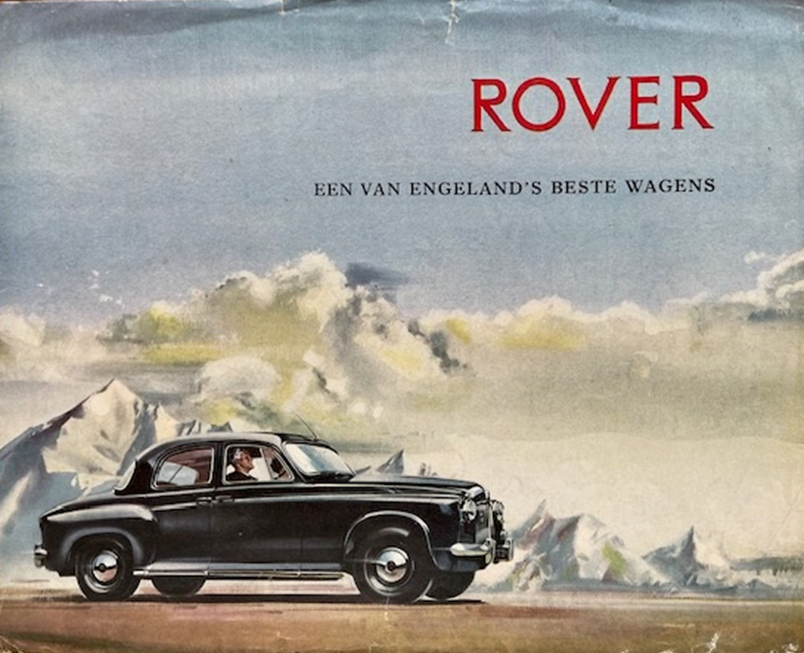
Rover 60, 75, 90, 105
folder, 8 pages, Dutch
published c1958
Dating
in the text model year 1958 is mentioned
publicity code 549
In October 1959, the P4 range was streamlined to just two models: the four-cylinder Rover 80 and the six-cylinder Rover 100. The Rover 100 replaced the earlier 90 and 105 models and was powered by a new 2,625 cc straight-six engine. It combined stronger performance with traditional Rover refinement: leather and wood trim, the choice of bench or individual front seats, a standard heater and standard overdrive on top gear. Production of the 100 continued until 1962, by which time 16,521 units had been built. Alongside it, the Rover 80 used a completely different 2,294 cc four-cylinder engine derived from the Land Rover. However, the four-cylinder models proved unpopular, and only around 5,900 were produced.
1959

Rover 80, 100
brochure, 16 pages, English
published c1959
Dating
the text emphasises the 80 and 100 are new models
publicity code 586

Rover 80, 100
folder, 8 pages, English
published c1959
Dating
the text emphasises the 80 and 100 are new models
publicity code 587

Rover 80, 100
folder, 8 pages, Dutch
published c1959
Dating
the text emphasises the 80 and 100 are new models
publicity code 587/Dutch/4
1961

Rover 80, 100
brochure, 16 pages, English
published c1961
Dating
publicity code 617

Rover 80, 100
folder, 8 pages, English
published c1961
Dating
publicity code 618
Announced in September 1962, the 95 and 110 marked the final evolution of the P4. Cost reductions included the use of steel rather than alloy door panels, signalling the model’s approaching retirement. The last P4 left the production line in May 1964, just months after the launch of the entirely new Rover 2000.
1962

Rover 95, 110
brochure, 16 pages, English
published c1962
Dating
the brochure text emphasises the 95 and 110 are new models
publicity code 636/A
Maak jouw eigen website met JouwWeb