Ford
Capri
1969-1986
The Ford Capri was launched in January 1969 at the Brussels Motor Show. Designed by Philip T. Clark, who had also worked on the Mustang, the Capri aimed to bring American-style coupé flair to a European audience. During development, the project was known as “Colt,” but the name had to be dropped due to Mitsubishi holding the rights. Underneath the sleek fastback body, the Capri was based mechanically on the Ford Cortina. Smaller models used British-built four-cylinder units, while the German-built cars received V4 engines from the Ford Taunus. A performance version followed in September 1970, when the Capri RS 2600 was introduced, featuring a fuel-injected 2,637 cc V6 and lightweight body panels. It was succeeded in late 1973 by the more powerful RS 3100.
1969

Ford Capri
folder, 12 pages, Dutch
published 10-69
Dating
publicity code 915941/6910/60M
1970

Ford Capri
brochure, 16 pages, Dutch
published 08-70
Dating
publicity code 103611/7008/40M

Ford Capri
folder, 8 pages, Dutch
published 08-70
Dating
publicity code 103614/7008/65M
1971

Ford Capri
folder, 8 pages, Dutch
published 02-71
Dating
publicity code 103652/7102/55M
1972

Ford Capri
brochure, 16 pages, Dutch
published 08-72
Dating
publicity code PN 344595/7208/15m

Ford Capri RS 2600
brochure, 8 pages, Dutch
published c1972
Dating
in 1972 the RS 2600 received new wheels, bumpers and a new steering wheel as in the brochure
The Ford Capri II was introduced in February 1974. While it retained the rear-wheel-drive layout and overall proportions, it featured a smoother, more modern styling. Its enlarged rear hatch made it far more practical than its predecessor. Interior comfort and equipment were improved, aligning the Capri more closely with the growing demand for practical, family-friendly coupés. Though never intended as a pure sports car, the Mk2 maintained a strong following among drivers who appreciated its mix of style, space, and performance.
1974

Ford Capri II
folder, 8 pages, Dutch
published 01-74
Dating
publicity code PN 402939/7401/40m

Ford Capri II
brochure, 12 pages, Dutch
published 09-74
Dating
publicity code PN 470631/7409/21.2m
1976

Ford Capri
brochure, 12 pages, Dutch
published 08-76
Dating
publicity code PN 056506/7608/13,5m
1977
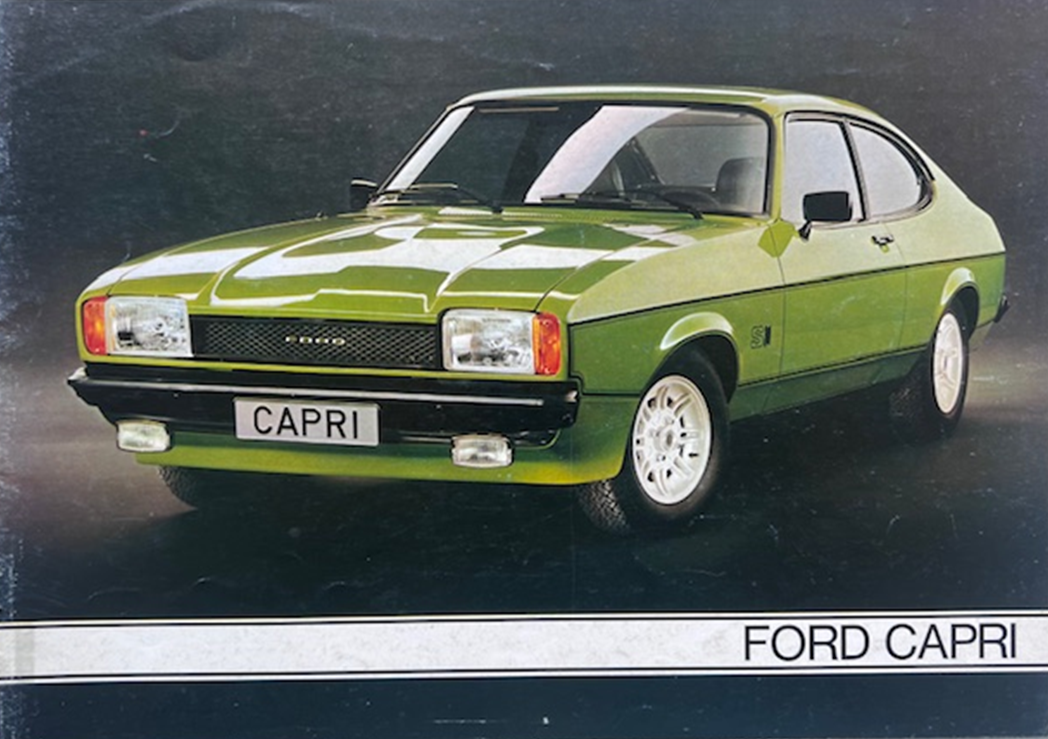
Ford Capri
brochure, 16 pages, Dutch
published 09-77
Dating
publicity code PN 106298/7709/15m
The Mk3 was introduced in 1978, featuring a redesigned front end with quad headlights and a sleeker, more aerodynamic profile that gave the car a sharper look. It continued to offer a broad range of engines, from economical four-cylinder units to the well-regarded 2,994 cc V6 in the high-performance versions. Production ended in 1986, marking the end of the Capri line after nearly two decades.
1978

Ford Capri
brochure, 16 pages, Dutch
published 02-78
Dating
publicity code PN 2667288/78/2/19,8m

Ford Capri
folder, 8 pages, Dutch
published 11-78
Dating
publicity code PN 240766/7811/24,8m
1979

Ford Capri
brochure, 16 pages, Dutch
published 09-79
Dating
publicity code PN 319012/7909/15,4m
Maak jouw eigen website met JouwWeb