Standard
Vanguard, Ensign
1948-1963
The Standard Vanguard was first exhibited to the public at the Brussels Motor Show in February 1948. It was Standard's first newly designed post-World War II car and intended for export around the world. The name of the car recalled the HMS Vanguard, the last of the Royal Navy's battleships, launched in 1944. Permission to use the name involved extensive negotiations with senior Royal Navy personnel. The Vanguard was fitted with a four-cylinder 2,088 cc engine, which was essentially the same as the one made for the Ferguson TE20 tractor, with some changes for automobile use.
1950
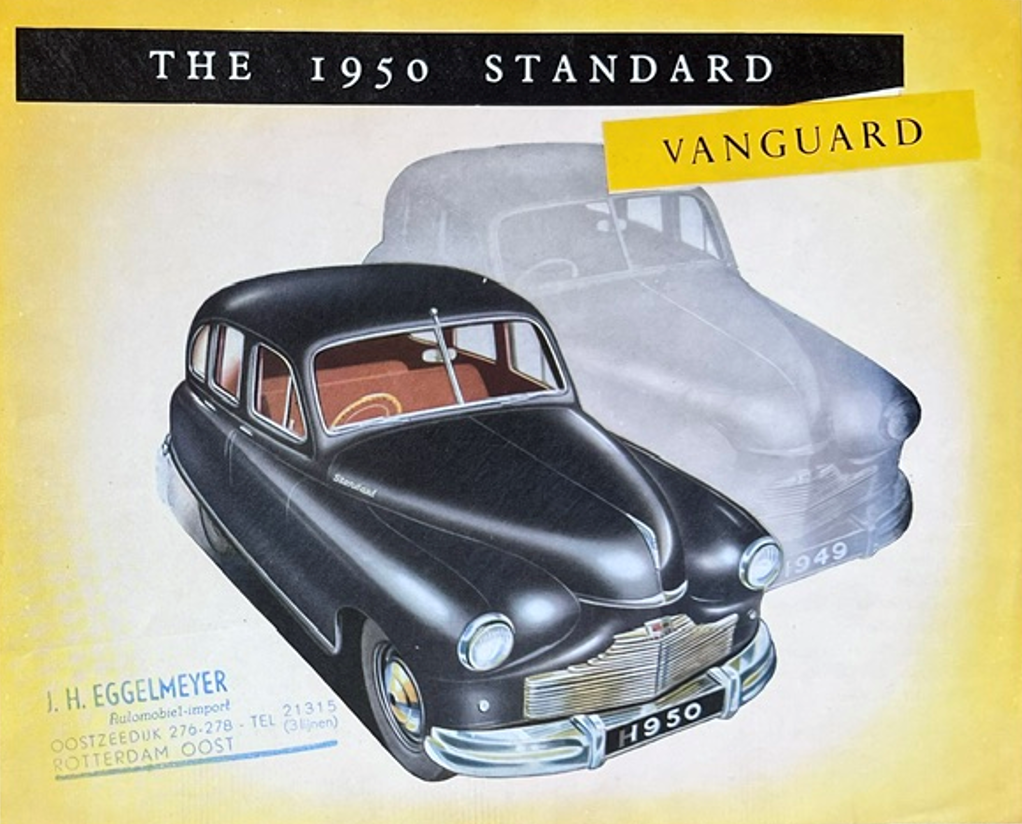
Standard Vanguard
folder, 4 pages, English
published 06-50
Dating
6/50 is printed on the back
1951

Standard Vanguard
folder, 4 pages, English
published 10-51
Dating
1051 is printed on the back
1952

Standard Estate car
folder, 4 pages, English
published 01-52
Dating
publicity code 1.52 H.A.S.

Standard Estate car
folder, 4 pages, English
published 10-52
Dating
publicity code 10/52 H.A.S.
The Phase III, released to the market for the mid-October 1955 British International Motor Show, was a radical change with the elimination of the separate chassis. The new body was lower and had an increased glass area, making it look much more modern, and the old two-piece flat windscreen gave way to a one-piece curved design. A basic model, the Standard Ensign, with 1,670 cc engine, was announced in October 1957. The Ensign shared its body with the Vanguard Series III, but had a cheapened specification in various respects, including a mesh front grille and a simplified instrument panel and dashboard. Despite the generally lower specification, the Ensign was the first Vanguard-based car to have a four-speed gearbox. An Ensign De Luxe version followed in 1962 with a larger 2,138 cc engine. Unlike the smaller-engined original version, the De Luxe was also available as a station wagon.
1956

Standard Vanguard III de luxe
brochure, 8 pages, English
published 10-56
Dating
publicity code 151/10/56
1957

Standard Vanguard Estate car
folder, 8 pages, English
published 10-57
Dating
publicity code 251/10/57
1958

Standard Ensign
folder, 8 pages, English
published 01-58
Dating
publicity code 236/1/58
Introduced at the end of 1960, the Vanguard Six featured a six-cylinder 1,998 cc engine; this was the engine subsequently installed in the Triumph 2000. Externally the only differences from the Vignale were the badging but the interior was updated. After Leyland Motors took over Standard-Triumph in 1960, both the Ensign and the Vanguard were replaced by the Triumph 2000 in 1963. After 60 years the Standard name disappeared from the market.
1960

Standard Vanguard Six
brochure, 20 pages, English
published 10-60
Dating
publicity code 319/10/60/Exp

Standard Vanguard Six Estate car
folder, 4 pages, English
published 10-60
Dating
publicity code REF 328/10/60/UK
1961

Standard Vanguard Six Estate car
folder, 4 pages, English
published 01-61
Dating
publicity code REF 328/161/UK-25000
Maak jouw eigen website met JouwWeb