Porsche
356
1950-1965
Conceived by Ferry Porsche and inspired by the philosophy of combining low weight with sufficient power, the first Porsche 356 was hand built in Gmünd, Austria in June 1948. It had a newly designed chassis, an aluminum body and a four-cylinder, air-cooled 1,086 cc rear-engine. After around 50 cars had been made, production moved to Zuffenhausen, Germany in 1950. From then on the 356 was steel-bodied. The aluminum-bodied cars from Gmünd are now considered prototypes. The 356 quickly earned a reputation for excellent handling, reliability and sporting performance. Available as both a coupé and an open-top model, it proved successful on road and track alike, including a class victory at Le Mans in 1951. The original “pre-A” models, built until 1955, are distinguished by their split windscreen (1948–1952) or later bent one-piece windscreen (1953–1955). Engine sizes grew from 1,086 cc to 1,286 cc and 1,488 cc, while more powerful “Super” versions appeared from 1953 onwards. In 1954 Porsche introduced the legendary Carrera engine, further enhancing the car’s performance credentials.
1952
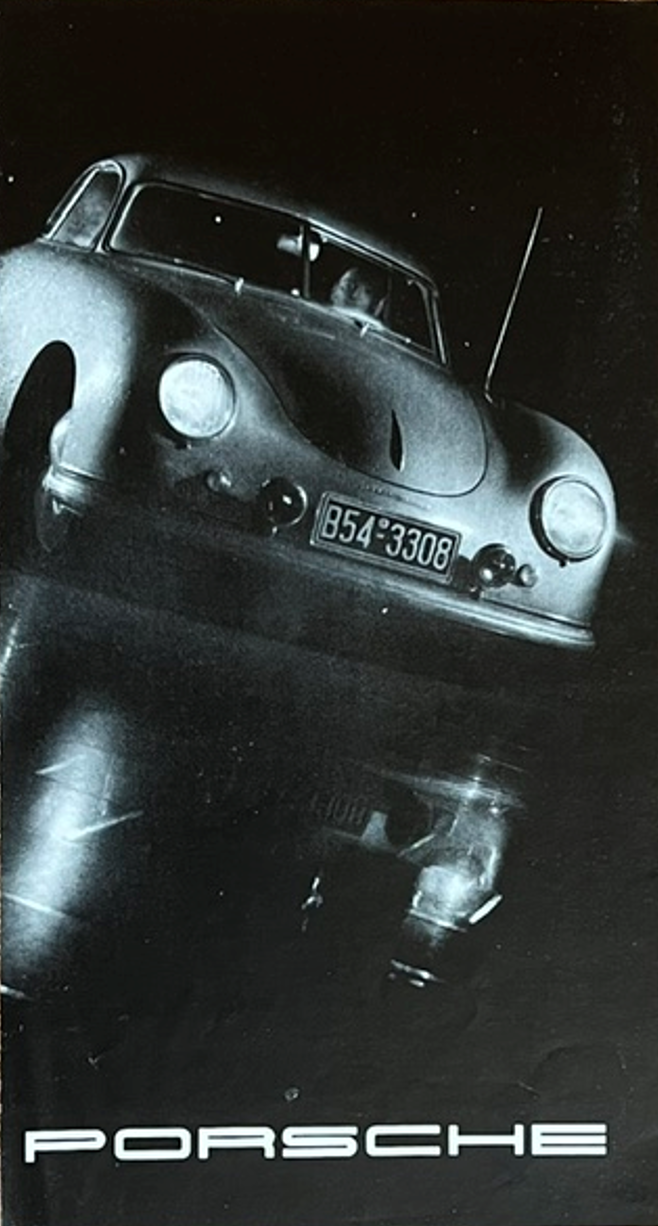
Porsche 356
folder, 4 pages, German
published c1952
Dating
on the back the 1952 rallye wins are listed; the car has the split windscreen which was replaced by a single windscreen in 1953
At the 1959 Internationale Automobil-Ausstellung in Frankfurt, Porsche presented the 356 B. The front end was redesigned with new, slightly raised bumpers and headlights. The 1,582 cc engine also became available in a tuned, 90 hp version. In addition to the cabriolet, a cheaper, more spartan roadster was introduced. In 1962 the car was updated with larger wind screens, twin grilles on the engine lid and an enlarged luggage space.
1959

Porsche 356 B
folder, 8 pages, English
published 09-59
Dating
publicity code 9.59 20 M 2 Ra
1962

Porsche 356 B
brochure, 12 pages, English
published 01-62
Dating
publicity code 30M 1.62 GI

Porsche 356 B
brochure, 22 pages, German
published 02-62
Dating
publicity code 10M 2.62
The last revision of the 356 was the 356 C introduced for the 1964 model year. The most notable difference with its predecessor are the disc brakes all around. Production of the 356 peaked at 14,151 cars in 1964, the year that its successor, the Porsche 901, was introduced. The last ten 356s were cabriolets, assembled for the Dutch highway patrolling rijkspolitie.
1963

Porsche 356 C
brochure, 12 pages, German
published 09-63
Dating
publicity code 20 M 9.63 G
1964

Porsche 356 C
brochure, 12 pages, German
published 10-64
Dating
publicity code 15 M 10.64 Gl
Maak jouw eigen website met JouwWeb