Land Rover
Land Rover
1948-1985
The Land Rover was conceived by the Rover Company in 1947 during the aftermath of World War II. Before the war Rover had produced luxury cars which were not in demand in the immediate post-war period and raw materials were strictly rationed to those companies building construction or industrial equipment, or products that could be widely exported to earn crucial foreign exchange for the country. Maurice Wilks, Rover's chief designer came up with a plan to produce a light agricultural and utility vehicle, of a similar concept to the Willys Jeep used in the war, but with an emphasis on agricultural use. The first prototype was built on a Jeep chassis and used the engine and gearbox out of a Rover P3 saloon car. The bodywork was handmade out of an aluminium/magnesium alloy to save on steel, which was closely rationed. The choice of colour was dictated by military surplus supplies of aircraft cockpit paint, so early vehicles only came in various shades of light green. The Land Rover entered production in 1948 with what has later been termed the Series I, which was launched at the 1948 Amsterdam Motor Show.
1948

Land Rover
folder, 8 pages, French
published c1948
Dating
this is considered the first ever Land Rover folder, the 1949 station wagon is not mentioned and as of 1950 the head lights were no longer positioned behind the mesh grille
1952

Land Rover
folder, 12 pages, French
published c1952
Dating
the car has the 80 inch wheelbase which was produced until 1954 and the 2 litre engine which was introduced in 1952
1954

Land Rover LWB
folder, 6 pages, French
published 09-54
Dating
september 1954 is printed on the back
1955

Land Rover SWB station wagon
folder, 4 pages, English
published c1955
Dating
the all-metal station wagon was introduced in 1955, the 86 inch wheelbase was extended to 88 inch in mid-1956
The Series II, introduced in 1958, was the first Land Rover to receive the attention of Rover's styling department. Chief Stylist David Bache produced the familiar barrel side waistline, with a 5 inch greater width to cover the vehicle's wider tracks. It came in 88 inch and 109 inch wheelbases, normally referred to as the 'SWB' and 'LWB'. It was available with the existing 2,052 cc diesel engine or a new 2,286 cc petrol engine. There was some degree of overlap between Series I and II production. Early Series II 88-inch vehicles were fitted with the old 1,995 cc petrol engine to use up existing stock from production of the Series I. The 107-inch Station Wagon continued until late 1959 due to continued demand from export markets and to allow the production of Series II components to reach full level.
1959

Land Rover
brochure, 28 pages, English
published c1959
Dating
publicity code 568/C
1960

Land Rover
folder, 8 pagina's, Engels
uitgave c1960
Datering
de series II werd gebouwd van 1958-1961, in de series IIA was ook een 2,25 liter dieselmotor leverbaar, maar in de folder wordt alleen de oude 2,052 liter dieselmotor vermeld
publicity code 603/A
1970
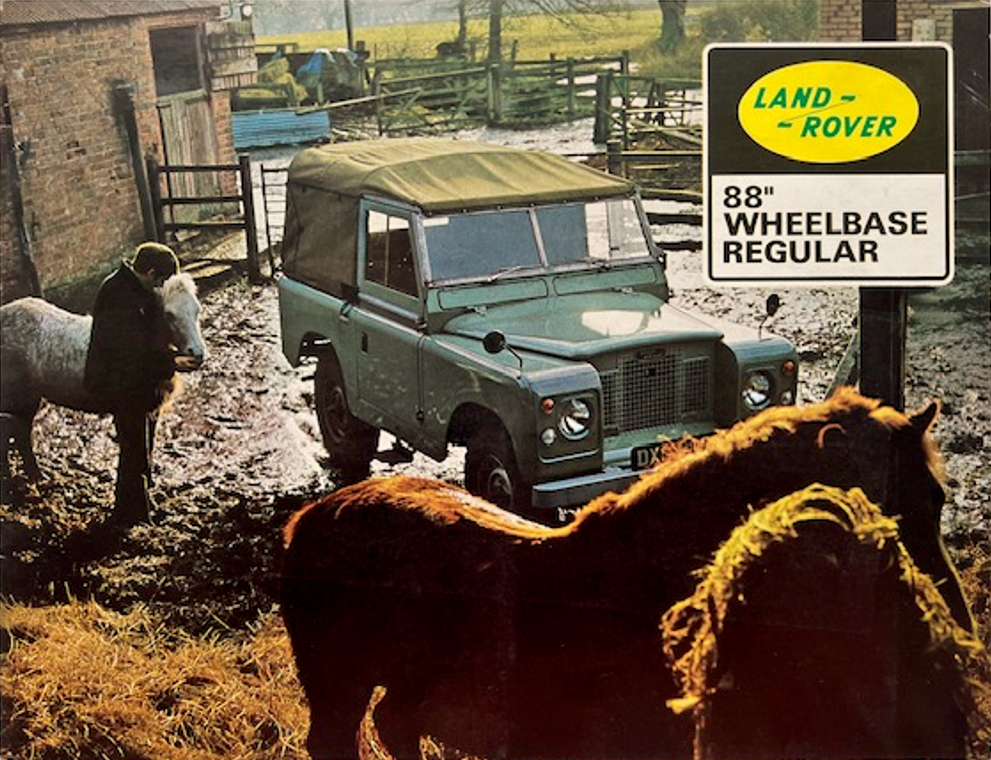
Land Rover 88
brochure, 22 pages, English
published c1970
Dating
in 1969 the head lamps were relocated to the wings, the 1971 series III had synchromesh on all gears; in this brochure only the third and fourth gear have it
publicity code 755

Land Rover 109
brochure, 22 pages, English
published c1970
Dating
in 1969 the head lamps were relocated to the wings, the 1971 series III had synchromesh on all gears; in this brochure only the third and fourth gear have it
publicity code 756

Land Rover
folder, 8 pages, French
published c1970
Dating
in 1969 the head lamps were relocated to the wings, the 1971 series III had synchromesh on all gears; in this folder only the third and fourth gear have it
The Series III, introduced in September 1971, had the same body and engine options as the preceding IIA. The metal grille was replaced with a plastic one. The Series III saw many changes later in its life as Land Rover updated the design to meet increased competition. In July 1979, a 3,528 cc V8 engine was introduced. It was derived from a Buick engine and was first used in the 1970 Range Rover.
1971

Land Rover
folder, 8 pages, French
published 09-71
Dating
publicity code 806/9.71

Land Rover 88, 109 station wagon
brochure, 20 pages, English
published 09-71
Dating
publicity code 813/9.71

Land Rover 109
brochure, 18 pages, English
published 10-71
Dating
publicity code 812/10.71
1972

Land Rover 88
brochure, 16 pages, English
published 01-72
Dating
publicity code 811/1.72
1974

Land Rover 109
brochure, 16 pages, English
published 03-74
Dating
publicity code 1036/3.74

Land Rover 88, 109 station wagon
brochure, 16 pages, English
published 06-74
Dating
publicity code R 1032/6.74

Land Rover
brochure, 26 pages, English
published 07-74
Dating
code 35/1 (87210) 7/74 - 10,000
1976

Land Rover
folder, 8 pages, English
published c1976
Dating
the car has the 1976 plastic dashboard; all engine options are mentioned, except the 1979 V8
1977

Land Rover
brochure, 22 pages, English
published 02-77
Dating
publicity code
26/55 (92605) 2/77-100m
1979

Land Rover V8
folder, 6 pages, Dutch
published c1979
Dating
the V8 was introduced in 1979; the folder emphsasis this is a new model
Maak jouw eigen website met JouwWeb