Ford
Escort
The Ford Escort was introduced in Ireland and the United Kingdom at the end of 1967, making its show debut at the Brussels Motor Show in January 1968. It replaced the successful, long-running Anglia. The Escort was presented as the first passenger car to be developed by the merged Ford of Europe. Escort production commenced at the Halewood plant in England during the closing months of 1967, and for left-hand-drive markets in September 1968 at the Ford plant in Genk, Belgium. Initially, the Escort was sold as a two-door saloon. A two-door estate was introduced at the end of March 1968, followed by a panel van in April 1968 and a four-door saloon in 1969. During 1968, a higher-performance version, the Escort Twin Cam, became available. It had a 1,558 cc engine, originally developed for the Lotus Elan. Production of the Twin Cam was phased out as the Cosworth-engined RS 1600 (RS denoting Rallye Sport) production began in March 1970. The Escort eventually went on to become one of the most successful rally cars of all time. The Ford works team was practically unbeatable in the late 1960s and early 1970s. Perhaps the Escort's greatest victory was in the 1970 London to Mexico World Cup Rally, giving rise to the Escort Mexico, introduced in November 1970. Both the Mexico and RS 1600 were built at Ford's Advanced Vehicle Operations (AVO) facility located in South Essex. As well as higher-performance engines and sports suspension, these models featured a strengthened bodyshell. Ford also produced an RS 2000 model, featuring a 1,993 cc engine.
1967

Ford Escort
folder, 12 pages, Dutch
published 12-67
Dating
publicity code 291846/CE220/6712/60M
1968

Ford Escort
brochure, 18 pages, Dutch
published 03-68
Dating
publicity code 463955/CE239/683/40M

Ford Escort
folded brochure, 24 pages, Dutch
published 08-68
Dating
publicity code 748608/CE269/688/80M
1969

Ford Escort
brochure, 16 pages, Dutch
published 05-69
Dating
publicity code 748751/695/75M

Ford Escort
brochure, 16 pages, Dutch
published 08-69
Dating
publicity code PN/698/67m
1970

Ford Escort
brochure, 8 pages, Dutch
published 08-70
Dating
publicity code 103613/7008/195M
1971

Ford Escort
brochure, 8 pages, Dutch
published 02-71
Dating
publicity code 103653/712/110M
1972

Ford Escort
brochure, 20 pages, Dutch
published 02-72
Dating
publicity code PN 263704/7202/70m

Ford Escort
brochure, 20 pages, Dutch
published 08-72
Dating
publicity code PN 344583/7208/70m
1973

Ford Escort RS 2000
folder, 8 pages, German
published c1973
Dating
the RS 2000 was launched in June 1973, in the folder it is presented as new

Ford Escort
brochure, 20 pages, Dutch
published 08-73
Dating
publicity code PN 415614/7308/75m

Ford Escort
folder, 8 pages, Dutch
published 08-73
Dating
publicity code PN 415616/7308/125m
1974

Ford Escort
brochure, 12 pages, Dutch
published 04-74
Dating
publicity code PN 451759/7404/75M

Ford Escort
folder, 4 pages, Dutch
published 04-74
Dating
publicity code PN 451769/7404/7m
The second generation Escort was introduced in January 1975. It retained the same rear-wheel-drive platform and mechanical layout, but featured completely new bodywork with more angular styling in line with mid-1970s design trends. The car was available in a wide range of trim levels and body styles, including two- and four-door saloons, estates, and panel vans. It also continued Ford’s emphasis on motorsport and performance with versions like the Escort Sport, RS Mexico, and the high-performance RS 1800, which used a Cosworth engine and became a dominant force in international rallying. Production ended in 1980, when it was replaced by the all-new, front-wheel-drive Escort Mk3.
1975

Ford Escort
folder, 8 pages, Dutch
published 01-75
Dating
publicity code PN 470698/7501/86m

Ford Escort
brochure, 12 pages, Dutch
published 08-75
Dating
publicity code PN 493199/7508/90m
1976

Ford Escort
folder, 8 pages, Dutch
published 09-76
Dating
publicity code PN 056508/7609/20m

Ford Escort
folder, 8 pages, Dutch
published 12-76
Dating
publicity code PN 075034/7612/36m
1977
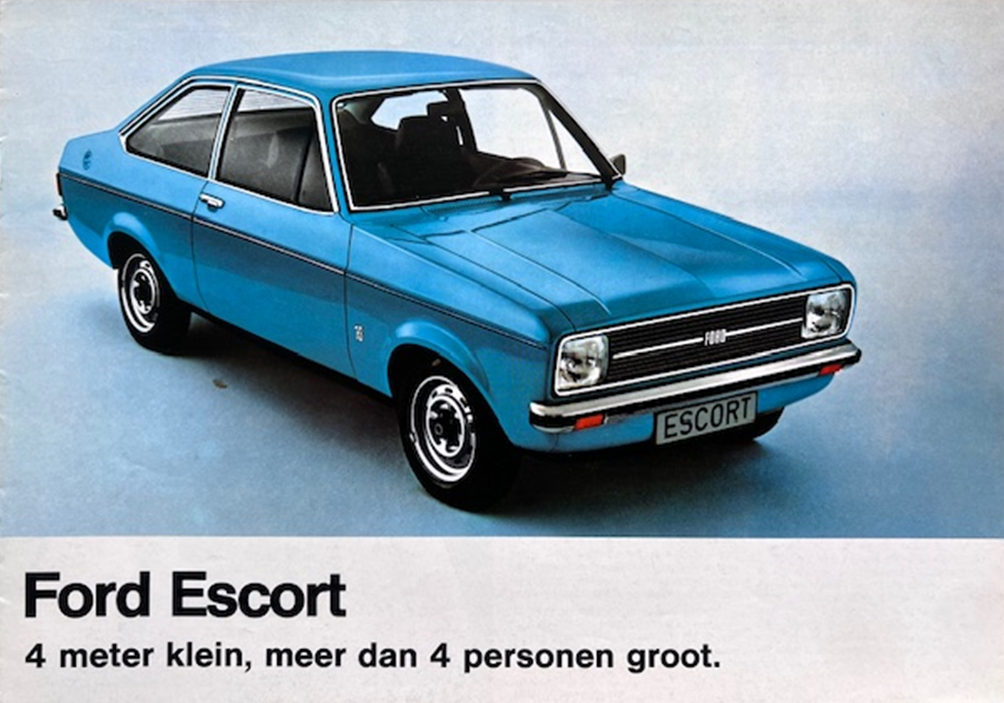
Ford Escort
brochure, 12 pages, Dutch
published 02-77
Dating
publicity code PN 075033/7702/59m

Ford Escort
brochure, 16 pages, Dutch
published 09-77
Dating
publicity code PN 106350/7709/80m
1978

Ford Escort
brochure, 16 pages, German
published 01-78
Dating
Januar '78 is printed on the back

Ford Escort
brochure, 20 pages, Dutch
published 07-78
Dating
publicity code PN 240635/7807/83.5m

Ford Escort
folder, 8 pages, Dutch
published 07-78
Dating
publicity code PN 240637/7807/20m
Maak jouw eigen website met JouwWeb