Citroën
2CV
1949-1990
In the 1930s France still had a large rural population which could not afford cars. Pierre-Jules Boulanger, vice-president of Citroën, realised the potential and sent a brief to his design team for a low-priced, rugged car that would enable four people to transport 50 kg of farm goods to the market at 50 km/h. One design parameter required that customers be able to transport eggs across a freshly ploughed field without breakage. The car received approval for the French market in August 1939 and was to be presented at the Mondial de l'automobile de Paris in October 1939. However, on September 3, France declared war on Germany which led to the cancellation of the 1939 motor show. The launch of the 2CV was postponed indefinitely.
After the war, resources were scarce and rationed, so it took until 1949 before Citroën was able to commence production. The 2CV was finally unveiled at the Mondial de l'automobile de Paris on 7 October 1948. The car on display was nearly identical to the 2CV that would be sold the next year, but it lacked an electric starter, the addition of which was decided the day before the opening of the Salon, replacing the pull cord starter. The canvas roof could be rolled completely open. The 2CV was fitted with an air-cooled, two-cylinder 375 cc engine, had one stop light and was only available in grey. Despite critics, Citroën was flooded with customer orders at the show. The 2CV was a commercial success: within months of it going on sale, there was a three-year waiting list, which soon increased to five years. In 1951, the Fourgonnette panel van was introduced.
1953

Citroën 2CV
sheet, French
published 08-53
Dating
publicity code A.C. 4996-8-53
1954

Citroën 2CV
sheet, French
published 01-54
Dating
publicity code A.C 5017-1-54
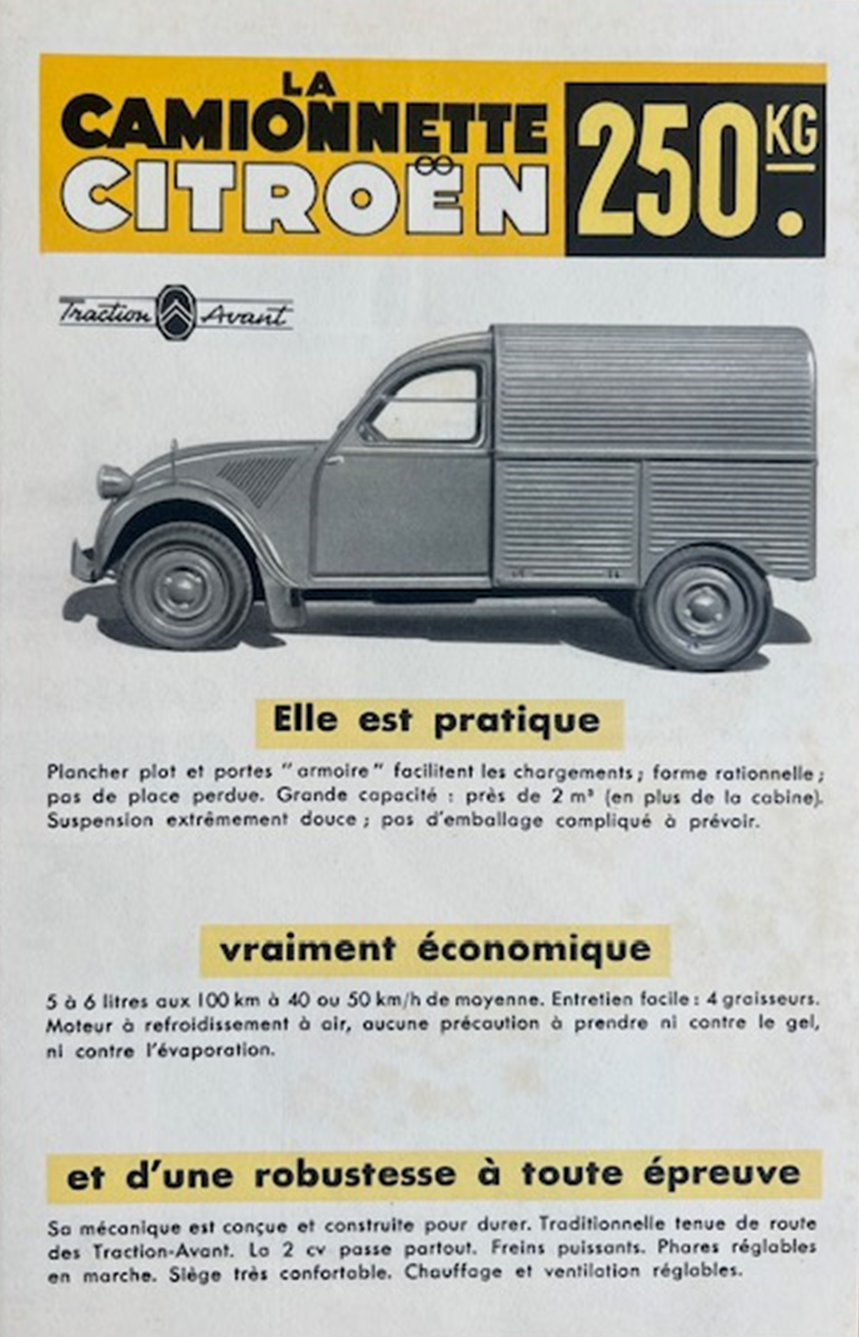
Citroën 2CV camionnette
folder, 4 pages, French
published 02-54
Dating
publicity code AC 5028-2-54
In 1955, a 425 cc engine became available and as of 1957 a heating and ventilation system was installed. In 1960, the production of the 375 cc engine ended. The corrugated metal bonnet was replaced by a five-rib glossy cover. Simultaneously, the grille was slightly modified. The 2CV Sahara appeared in December 1960. This had an additional engine-transmission unit in the rear, mounted the other way around and driving the rear wheels. The car had ample off-road capability, but at twice the price of the standard 2CV. 694 units were produced until 1968 and one more in 1971.
1955

Citroën 2CV
brochure, 20 pages, Dutch
published c1955
Dating
the Swedish brochure was printed in 1954, the car has the 1955 425 cc engine

Citroën 2CV
sheet, Dutch
published c1955
Dating
the sheet design is similar to the c1955 brochure
1959

Citroën 2CV
folder, 6 pages, Dutch
published 11-59
Dating
Novembre 1959 is printed on the back
1962

Citroën 2CV AZU
brochure, 28 pages, Dutch
published 06-62
Dating
publicity code AC 10074 6.62 1 HOL

Citroën 2CV
brochure, 32 pages, Dutch
published 12-62
Dating
publicity code E AZL A 1. HOL 12-62
1963

Citroën 2CV
folder, 4 pages, Dutch
published c1963
Dating
63 is printed on the cover

Citroën 2CV
brochure, 36 pages, Dutch
published 06-63
Dating
publicity code E AZL A 1. HOL 6-63

Citroën 2CV
sheet, Dutch
published c1963
Dating
63 is printed on the cover
1964

Citroën 2CV AZU
brochure, 28 pages, Dutch
published 01-64
Dating
publicity code AC 10 102 1.64 HOL
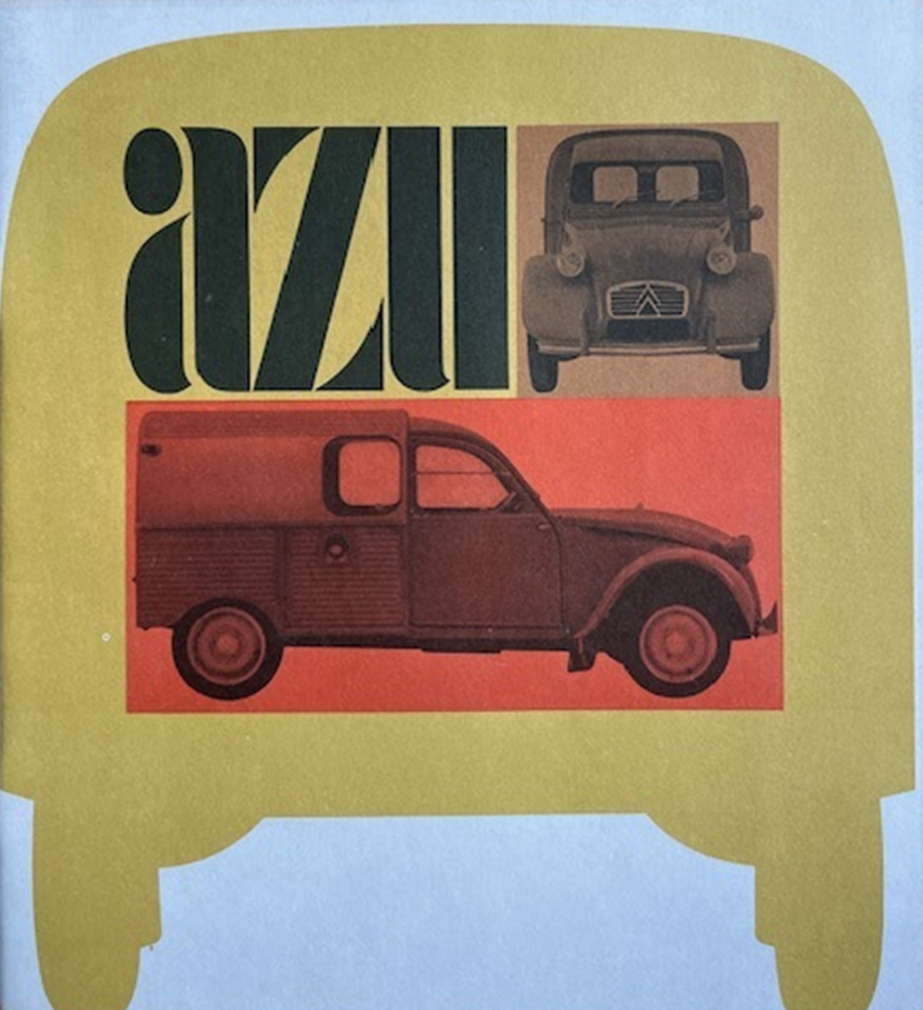
Citroën 2CV AZU, AK
brochure, 24 pages, Dutch
published 05-64
Dating
publicity code 10123-5-64 HOL.E.

Citroën 2CV
brochure, 36 pages, Dutch
published 06-64
Dating
publicity code E AZL A 1. HOL 6-64
1965

Citroën 2CV
brochure, 8 pages, Dutch
published 01-65
Dating
publicity code AC 10 144 1.65 HOL
In 1965 the suicide doors were replaced with front hinged doors. In February 1965, Citroën Belgium introduced the AZAM 6 which featured the 602 cc Ami 6 engine and the Ami's improved chassis. This version was manufactured until October 1967 and was also exported to a number of other countries, although it was never offered in France.
1965

Citroën Azam 6
brochure, 8 pages, Dutch
published c1965
Dating
the Azam 6 was built from February 1965 until October 1967, the brochure text is clearly an introduction to the new model

Citroën 2CV
brochure, 8 pages, Dutch
published 12-65
Dating
publicity code AC 10163-12-65 FLA
1966

Citroën Azam 6
brochure, 12 pages, Dutch
published c1966
Dating
the Azam 6 was built from February 1965 until October 1967, since there is a brochure from c1965, this brochure is from c1966-1967

Citroën 2CV
brochure, 16 pages, Dutch
published 03-66
Dating
publicity code AC 10163-3-66 HOL

Citroën 2CV
brochure, 36 pages, Dutch
published 09-66
Dating
9-66 is printed on the back
1967

Citroën 2CV AZU, AK
folder, 4 pages, Dutch
published 06-67
Dating
6.67 is printed on the back

Citroën 2CV
folder, 16 pages, Dutch
published 11-67
Dating
11.67 is printed inside
1968

Citroën 2CV
brochure, 16 pages, Dutch
published 01-68
Dating
1-68 is printed on the back

Citroën 2CV
folded folder, 4 pages, Dutch
published 10-68
Dating
10-68 is printed inside
1970

Citroën 2CV
folder, 8 pages, Dutch
published 02-70
Dating
2-70 is printed on the back

Citroën 2CV
folder, 6 pages, Dutch
published 07-70
Dating
7-70 is printed on the back

Citroën 2CV
brochure, 12 pages, Dutch
published 08-70
Dating
8-70 is printed on the back
1971

Citroën 2CV
folder, 6 pages, Dutch
published 09-71
Dating
9-71 is printed on the back

Citroën 2CV
folder, 20 pages, Dutch
published 09-71
Dating
9-71 is printed inside
1972

Citroën 2CV
folder, 6 pages, Dutch
published 09-72
Dating
9-72 is printed on the back
1973

Citroën 2CV
folder, 6 pages, Dutch
published 07-73
Dating
7-73 is printed on the back

Citroën 2CV
folder, 16 pages, Dutch
published 08-73
Dating
8-73 is printed inside
The last factory-issued brochure specifically for the 2CV was issued in 1973, as of 1974 only brochures of the whole two-cylinder range were published, see Model range two-cylinders.
1975

Citroën 2CV
sheet, Dutch
published 1975
Dating
on the back side 1975 is mentioned

Citroën 2CV special
sheet, Dutch
published c1975
Dating
the 2CV special was introduced in 1975
Maak jouw eigen website met JouwWeb